

Reviewed · OAHU WALKING TOURS
Downtown Honolulu Self Guided Walking Audio Tour
Honolulu’s royal past is not tucked away in a museum here. It unfolds along city streets, from the statue of Kamehameha I to ʻIolani Palace and the memorial to Queen Liliʻuokalani. I like that this route links famous landmarks to the people and political struggles behind them, and that its audio stories let you stop, pause, or skip at your own pace.
The main caveat is the technology. You need to download a separate app and enter a password before you start, and the instructions may feel fussy if you are not comfortable with phone setup. Get the app ready on strong Wi-Fi before heading out, then start in the morning, when Honolulu is cooler.
At a glance: a royal route with practical audio

- More than 23 audio stories connect major sights to Hawaiian leaders, political change, and the Pearl Harbor attack.
- A route of over 1.6 miles starts at Aloha Tower Marketplace and ends at the Queen Liliʻuokalani Statue.
- ʻIolani Palace is a highlight, the only royal palace in the United States, with the nearby barracks and government buildings adding context.
- The tour runs on your schedule: pause for a break, skip a story, or return to the audio later.
- Plan around the heat and the app: download everything in advance and aim for a morning start.
Start at Aloha Tower, then meet Kamehameha
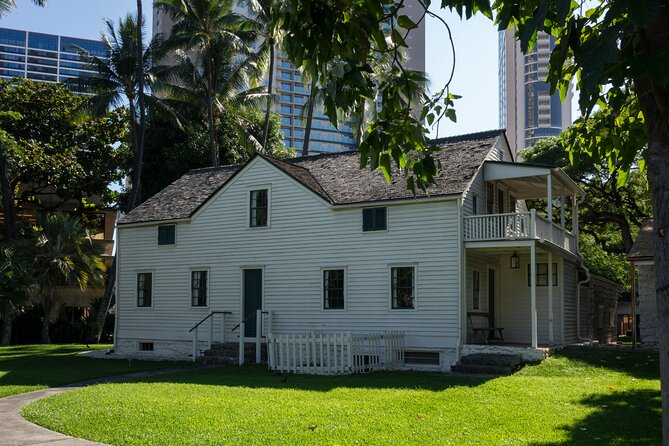
The stated starting point is Aloha Tower Marketplace, at 1 Aloha Tower Drive. No guide meets you there. Instead, you open the Action Tour Guide app at the first story location, and the audio is meant to begin as you reach it. The walk ends at the Queen Liliʻuokalani Statue.
The first named stop is the King Kamehameha Statue, where the tour sets a forceful tone. The stories introduce the conflicts among Hawaiian chiefs in the 1700s and Kamehameha’s role in the struggle for control of the islands. This is useful framing: the route is not just a procession of attractive public buildings. It asks you to consider how power was won, held, and later challenged.
Expect the audio to give you historical context rather than a live guide’s conversation. You can listen closely, take a photo, or pause if you want more time at a landmark. The route includes more than 23 stories, so the named stops are only part of the listening experience.
More walking tours in Oahu:
- Honolulu Haunts: Ghosts and Spirits Walking Tour
★ 4.2 · 169 reviews - Honolulu Downtown Walking Tour
★ 5.0 · 149 reviews - Kualoa Ranch – Horseback Walking Tour
★ 4.0 · 145 reviews
Kawaiahaʻo Church and the missionary era
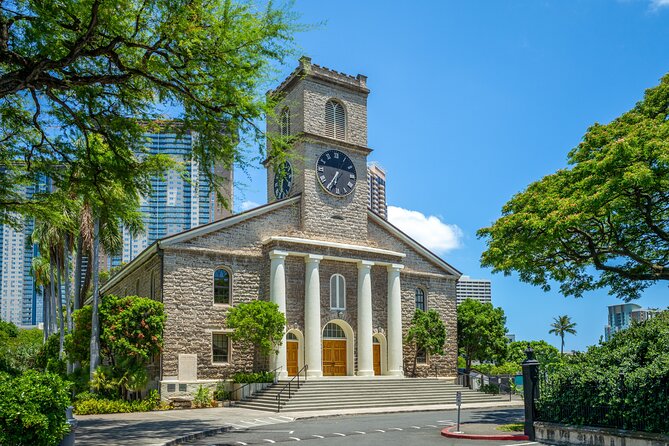
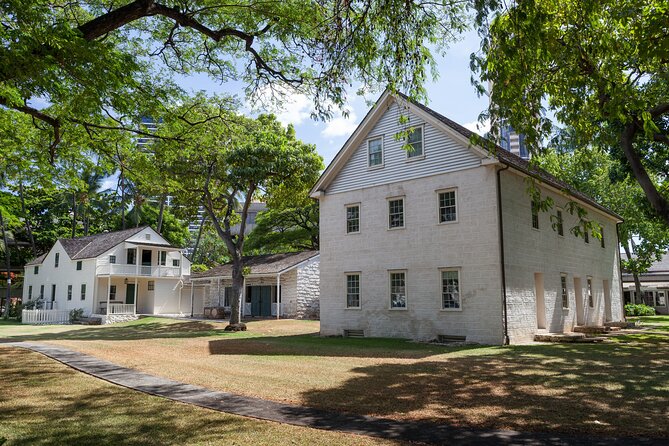
Kawaiahaʻo Church was once the national church of the Hawaiian Kingdom. Its place on the route helps show how religion and state life met in the islands, while a nearby museum stop introduces objects from Hawaii’s missionary period.
The museum is not identified by name in the tour details, so you should not count on a particular visit or admission being included. In fact, the tour price covers the audio experience, not attraction tickets, entry passes, or reservations. Treat the museum as a point of historical context, and check separately if you want to go inside somewhere along the way.
This section can help you think beyond a simple story of outside influence. Missionary history is part of Honolulu’s past, but so are Hawaiian institutions and the people who worked to preserve their authority. The audio’s value lies in placing these subjects on the same walk, rather than treating each building as an isolated photo stop.
Aliʻiōlani Hale and the shifting seat of power
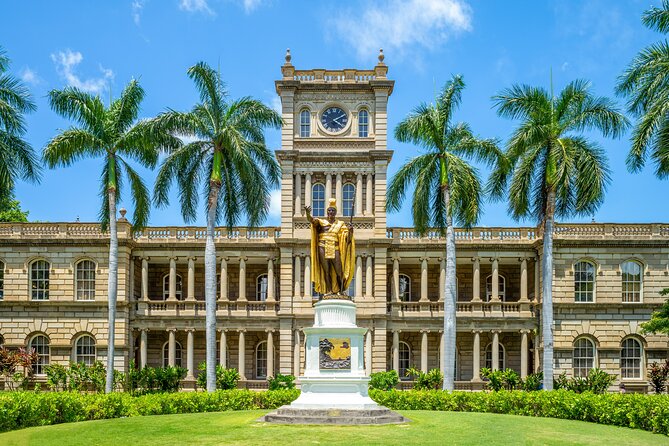
Aliʻiōlani Hale was built by Kamehameha V with the intention of serving as a palace for Hawaiian monarchs. King Kalākaua later chose to use it for government offices instead. That change gives the building an especially good role in this tour: its purpose shifted as the kingdom’s political needs changed.
The following stop, Honolulu Hale, brings the story into civic life. The account of Kalākaua’s return from a world tour in 1881 describes a city decorated to welcome him home, even as political opponents worked against his rule. The tour also explains the Reform Party and its growing influence after the 1875 Reciprocity Treaty.
These stories matter because they connect grand public celebrations to the less visible contest for political control. The tour’s route through government buildings gives you a street-level way to follow that contest. You are not asked to enter every building to understand its place in the story, though access to interiors is not included.
Patsy Takemoto Mink and Sky Gate
The Patsy Takemoto Mink statue shifts the focus from monarchs and nineteenth-century politics to a more recent figure. Mink was a third-generation Japanese American who grew up in Hawaii. Her memorial gives the tour a chance to recognize another part of the islands’ political history and the people who shaped it.
Nearby, Isamu Noguchi’s Sky Gate invites a different kind of stop. The work is made of curved black forms, and the audio offers a description of the artist’s intention as an evocation of Hawaii’s skies. You do not need to settle on one interpretation. Look at it for a moment, listen to the story, and see what the shape suggests to you.
These stops help break up the tour’s heavier political material. They also show that Honolulu’s public spaces hold more than statues of rulers: art and civic memory have their own place in the city.
More guided departures in Oahu:
- Moana’s Waikīkī Grand Guided Turtle Snorkel & Sailing Adventure
★ 4.5 · 936 reviews - Honolulu: Oahu Island Full-Day Guided Tour by Bus with Lunch
★ 4.6 · 506 reviews - Kailua 2-Hour Guided Kayaking Excursion, Oahu
★ 5.0 · 442 reviews - Chief’s Official Pearl Harbor Self-Guided Multimedia Tour
★ 4.0 · 407 reviews
The Capitol, the Eternal Flame, and Washington Place
At the Hawaii State Capitol, the audio points back to ʻIolani Palace, which served as the seat of government before the Capitol was built. The route then reaches the Eternal Flame Memorial, dedicated to those who died in the December 7, 1941 attack on Pearl Harbor.
Washington Place brings the story back to Queen Liliʻuokalani. The mansion was her home, and its place along the route offers a personal counterpoint to the official buildings nearby. Rather than presenting political history only through institutions, the tour connects it to the residence of the queen who lost her throne.
The walking route is about the city’s public memory as much as its architecture. You will hear about monarchy, government, war, and political change within a relatively compact area. That range is a strength, though it also means the audio moves quickly across subjects. Pause when a story catches your interest; you do not have to keep pace with a group.
ʻIolani Barracks, the Palace, and the Queen

The ʻIolani Barracks once housed the Queen’s Royal Guard, before the overthrow of Queen Liliʻuokalani. Its position near ʻIolani Palace makes the political shift especially tangible: the route brings you from the institutions of the monarchy to the forces that displaced it.
ʻIolani Palace dates to 1879 and is the only royal palace in the United States. Even from outside, it is a landmark worth lingering over. The tour’s account of its changing role gives you a reason to look beyond its architecture and consider what the building represented to the Hawaiian Kingdom.
The final stop is the Queen Liliʻuokalani Statue. The audio describes how she withdrew from public life and lived at Washington Place, where Native Hawaiians continued to visit her. It closes with her devotion to her people, making the statue a fitting endpoint for a route that has followed the monarchy’s rise, political crisis, and aftermath.
The ending is more reflective than triumphant. That suits the subject. The route asks you to remember that the end of a political reign did not end the queen’s importance to Native Hawaiians.
What $9.99 buys, and what it does not
At $9.99 per person, the tour is inexpensive if you want a structured introduction to central Honolulu and are happy to explore independently. You get a route, audio narration, location-based playback, offline maps, and extra stories for subjects you want to follow further. Lifetime access with no expiry means you can use it on a later trip as well.
You are not paying for a live guide, transportation, museum admission, or reservations. That distinction matters. If you prefer to ask questions in person or want someone else to manage the route, a guided tour may suit you better. If you like to set your own pace, the self-guided format gives you more freedom for less money.
The experience is sold for $9.99 per person, and the tour information says couples can save by sharing one tour and splitting headphones. The password can be used on the same number of devices as the number of travelers booked. If you want each person to use a separate phone, make sure your booking covers the devices you plan to use.
Set up the app before you leave
This is the most important practical advice: download the separate Action Tour Guide app while you have a strong Wi-Fi or cellular connection, then enter the password sent by email and text. Search your inbox and messages for audio tour if the setup instructions are hard to find. Once downloaded, the tour works offline, so you do not need a constant signal on the walk.
Bring headphones or earbuds. Stories are designed to play automatically as you reach their locations, which makes the walk easier to follow without repeatedly handling your phone. The app is recommended for an iPhone running iOS 15 or later, an Android device running version 9 or later, or a tablet with GPS and cellular connectivity.
The app is also the main risk. Some people may find the download, password, or launch process confusing, and there is no guide waiting at the start to troubleshoot in person. If the audio does not begin or directions go astray, the tour information advises contacting support. Build in a few minutes to check that the map and first story are working before you set off.
Timing, heat, and the best pace
The route is more than 1.6 miles and takes about one to two hours. The actual time depends on how long you spend at each stop, whether you pause for photos or breaks, and how many extra stories you play. The listed stops are marked at about ten minutes each, so you may need longer than an hour if you listen to everything and linger along the way.
Start in the morning if you can. Honolulu’s afternoon heat can make a walking tour less comfortable, and the route’s flexibility is useful if you need to step inside or take a break. The tour can be paused and resumed, even over multiple days, so there is no need to push through every story at once.
The listed operating hours are 9 a.m. to 6 p.m., Monday through Sunday. The start and finish are near public transportation, and the activity is described as suitable for most people. No special physical requirements are stated, but be prepared for a city walk of over 1.6 miles.
Who should book this Honolulu walk?
I would choose this tour if you want a low-cost introduction to Honolulu’s royal and political history, and you prefer to explore without a group schedule. It is especially useful if ʻIolani Palace, Queen Liliʻuokalani, and the history of the Hawaiian Kingdom are high on your list. The route links those subjects to public art, civic buildings, and Pearl Harbor memory in a way that can give your city walk a clear purpose.
It is less suited to you if you dislike smartphone setup, want a live guide, or expect admission to the museum or palace to be included. The narration and explicit walking directions are central to the experience, so test the app before leaving your hotel or another reliable connection.
Book it if you are comfortable using a phone app and want a flexible, history-focused walk for $9.99. Download it early, wear headphones, and go in the morning. If you would rather have a person lead the way and answer questions on the spot, look for a guided alternative.
FAQ
Where does the tour start and end?
It starts at Aloha Tower Marketplace, 1 Aloha Tower Drive, Honolulu. It ends at the Queen Liliʻuokalani Statue.
How long is the walking route?
The route is over 1.6 miles and takes about one to two hours. Extra stops, breaks, and additional audio stories can add time.
What language is the tour in?
The tour is offered in English.
Do I need internet while walking?
You need a strong Wi-Fi or cellular connection to download the tour. After it is downloaded, it works offline.
Are attraction tickets or reservations included?
No. Attraction passes, entry tickets, and reservations are not included in the $9.99 tour price.
What do I need to use the audio tour?
You need the separate Action Tour Guide app, the password sent after booking, and a compatible phone or tablet with GPS. Headphones or earbuds are recommended.
Can I cancel for a refund?
Yes. You can cancel for a full refund if you do so at least 24 hours before the experience’s start time. Cancellations or changes made within 24 hours are not accepted for a refund.
Just added in Oahu
- All-Inclusive Sunset Dolphin Watch and Snorkeling Cruise★ 4.5 · 8 reviews
- Sunrise Breakfast Cruise in Honolulu★ 3.5 · 48 reviews
- 3 Hour Sunrise Photo Tour with Malasada★ 5.0 · 81 reviews
- Best Oahu Self-Guided Driving Audio Tour: Beaches, History & More★ 3.5 · 10 reviews
- Private 90-Minute Spa and Massage in Honolulu★ 4.5 · 11 reviews
- Stand-Up Paddle Yoga on the North Shore of Oahu★ 5.0 · 3 reviews
- Kailua Stand Up Paddle Boarding Lesson★ 5.0 · 26 reviews
- Stand Up Paddle Board Lessons★ 5.0 · 12 reviews
Oahu Walking Tours, compared.

Honolulu Haunts: Ghosts and Spirits Walking Tour
Read our review →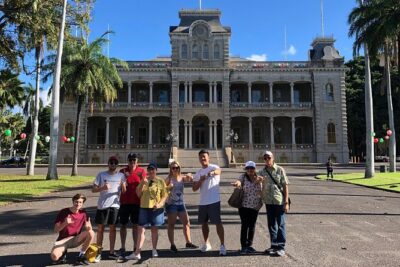




Honolulu Historic District a Smartphone Audio Walking Tour
Read our review →

Private Walking Food Tour in Honolulu With Secret Food Tours
Read our review →Browse the lists this tour appears in